
On Friday, Jan 23rd, in San Diego, the California Association of Local Behavioral Health Boards and Commissions (CALBHBC.org) met, and heard presentations from multiple California State Behavioral Health agencies, and some pioneering behavioral health programs. Here are transcripts and a summary of the conversations. Return here in a week to view the full videotape of the meeting.
Category: Uncategorized
January Behavioral Health Board Meeting Held
Last night, the Sonoma County Department of Health Services reported its disappointment in not being able to provide the Behavioral Health Board with its promised draft Three-Year Integrated Plan prior to its expected submission to the Sonoma County Executive Officer, and then to the California Department of Health Care Services. Said Jan Cobleda-Kegler, Behavioral Health Director, “Though the narrative is only waiting on one more program, the budget is still undone. I’m sorry. I’ve been waiting for this for three years.”
The Board’s responsibility is to advise the Department and the Board of Supervisors on the first-ever integration of more than $.5 billion worth of local, state, and federal funds which support homeless, mental health, and substance use disorder program for the next three years. “I don’t know how we’re going to do our job if we aren’t given time to review, gather input, and ask questions”, said Gregory Fearon, Chair of the Annual Report/Integrated Plan Subcommittee. The Committee will meet next on February 3rd in the Santa Rosa Conference Room at 1450 Neotomas Ave from 4-5pm.
Expanding Public Communication with Decision-Makers
The California Brown Act was passed long ago because we believe that the public decisions should be made publicly. Its purpose was to keep the conversations between members of legislative bodies from happening in private, out of sight and ears of the public. The extreme restrictions which were enacted into law actually limited the views of the decision-makers from being shared in any venue but open public meetings which were clearly publicized. This meant mostly that everyone involved in communicating during the decision-making process had to shut up unless they were sitting in the actual meetings. Making sure that the public could hear every word of the conversations that decision-makers said to each other was the primary purpose of the Brown Act. What was sacrificed was allowing the conversations between the public and the decision-makers unless it took place in the very few moments when official meetings of the legislative bodies met.
This important change to the Brown Act still forbids conversations between members of the legislative bodies even on the internet-based social media platforms. It only opens up the possibility of communication between individual members of the legislative bodies and the public. And I’m proposing that the communication be even more focused by having the discussion topic be a proposed plan document, report, or regulation. Placing these documents on an open, accessible website which allows the public to directly comment in real time, provides manageable, productive advice from the public in a greatly-expanded stakeholder engagement process.
A New Opportunity for Open Government Communication
The California Legislature, enacting reforms to its well-known Brown Act, has extended indefinitely a little known allowance for members of legislative bodies to communicate “outside of a meeting with any other person using n internet-based social media platform for specified purposes”. The allowance “shall not be construed as preventing a member of the legislative body from engaging in separate conversations or communications on an internet-based social media platform to answer questions, provide information to the public, or to solicit information from the public regarding a matter that is the subject matter jurisdiction of the legislative body provided that a majority of the members of the legislative body do not use the internet-based social media platform to discuss among themselves business of a specific nature that is within the subject matter jurisdiction of the legislative body.”
Legislative bodies impacted by SB 707 include California counties and cities, and their appointed advisory commissions and boards, and school district governing boards.
My use of this internet-based website (www.heapa.org) to “provide information to the public and solicit information from the public” regarding the issues being discussed by the Sonoma County Behavioral Health Board is now legally allowed by this new California law. I will be posting documents for the public’s review and comment that we are developing to fulfill our responsibilities as defined by the Sonoma County Board of Supervisors.
Behavioral Health Board Plans for Annual Report, and Three-Year Integrated Plan
Recent Changes in the Brown Act Allow Greater Public Review
The Annual Report/Integrated Plan Standing Committee of the Behavioral Health Board had its first meeting on January 6th, and agreed to conduct a three-month research project to acquire and publish all useful materials on what they are calling “The Health of Health Services” in Sonoma County. Preparing for their review of the County’s Three-Year Integrated Plan for the County Department of Health Services, effective beginning July 1, 2026, the Board feels it needs to gain the greatest insight into the capability of the County to provide an effective safety net of services. Recent cutbacks and indications of diminished federal and state funds for traditional safety net programs threaten to unravel existing support for most county services for low income residents. The Board believes that, in order to advise the Board of Supervisors on a prospective three-year plan beginning on July 1, 2026, it needs to know what damage to the current system will be done before then.
An online library of all reports from: 1) listening sessions and stakeholder meeting conducted by the Department of Health Services; 2) needs assessments gathered; 3) requests for funding submitted to any of the Department’s notice of funding available; and 4) comments and testimony from providers and recipients on their perceptions of the strengths and weaknesses of the current system of care will be made available to the public and Committee members.
Behavioral Health Board Annual Report/Integrated Plan Committee Meets
Greetings!
As you know, the Sonoma County Board of Supervisors-approved Bylaws of the Behavioral Health Board (BHB) require the BHB to:
- Submit an annual report to the Sonoma County Board of Supervisors on the needs and performance of the County’s behavioral health system.
- Advise the Sonoma County Board of Supervisors and the local behavioral health director as to any aspect of the local behavioral health and substance use disorder programs.
- Review and approve the procedures used to ensure citizen and professional involvement at all stage of the planning process.
- Review and comment on the County’s performance outcome data and communicate its findings to the State Behavioral Health Planning Council.
The BHB has determined that, in order to produce our bylaws-required Annual Report, to fulfill its remaining responsibilities under the bylaws, and to fulfill its responsibilities under the legislation known as Proposition One (to advise the Sonoma County Department of Health Services (DHS) on the development of its required three-year Integrated Plan), the BHB needed to establish a Standing Committee consisting of four members of the BHB. The BHB voted to establish an Annual Report/Integrated Plan Committee, and three of its members were appointed to the Committee at its meeting on November 18, 2025. The Committee members are Gregory Fearon (Chair), Alexandra Jacobs, and Angelina Grab.
The BHB’s Annual Report/Integrated Plan Committee (AR/IP) met for its first meeting on January 6th, 2026 from 4pm-5pm in the Santa Rosa Conference Room at 1450 Neotomas Way, Santa Rosa. BHB Members Alexandra Jacobs and Gregory Fearon were in attendance. Member Angelina Grab attempted to join via Zoom, but failed to succeed due to erroneous posting information from DHS on the published agenda.
The discussion which occurred focused on the two questions posed on the noticed agenda:
- How to Gather Annual Report Material
- How to Review and Advise the Department and Board on its Integrated Plan .
The AR/IP Committee decided to undertake three activities which will support its development of its Annual Report to the Sonoma County Board of Supervisors over the next three months;
- Assemble and publish, available to the public, all materials it can find on the “Health of Health Services” in a format which allows members of the public to comment in real time on the materials.
- Prior to each monthly meeting of the AR/IP Committee, provide editorial direction toward phased completion of the Annual Report
- By March 31st, approve and forward a proposed BHB AR/IP Committee-Recommended Annual Report to the BHB, and DHS.
The Committee also discussed a workplan to meet its responsibilities to advise DHS, and the Sonoma County Board of Supervisors, on the Proposition One FY 26-29 Integrated Plan. The proposed Integrated Plan is being developed by DHS, and staff provided the BHB with a schedule last July which outlined DHS activities conducting stakeholder input, internal Department research, and collaboration with the California Department of Health Care Services (CDHCS) in anticipation of forwarding a draft Integrated Plan to the Sonoma County Executive Officer this month for approval, and to the CDHCS by March 31st. Upon receiving comments from CDHCS, DHS is then planning on producing a final draft of the Integrated Plan, which would then be published and set for a public hearing at the May 18th meeting of the BHB. Comments received from the BHB and the public would be considered for inclusion in the recommended Final Integrated Plan presented to the Sonoma County Board of Supervisors for approval at its June 16th meeting.
The AR/IP Committee adjourned its first meeting at 5:20pm.
HEAPA.org Story Grant
Evidence for Systemic Change – 01-04-26
Resident Health Care
CBO: Millions Will Lose US Health Coverage If ACA Subsidies Expire
A new report released by the Congressional Budget Office (CBO) found that if the Affordable Care Act’s (ACA) extended subsidies are allowed to expire at the end of 2025, millions of people will become uninsured and premiums will rise.
Responding to the Senate Finance Committee, the CBO found that “not extending the credit will increase the number of people without health insurance and raise the average gross benchmark premiums for plans purchased through the marketplaces”, The Hill reported.The extended tax subsidies were first enacted in 2021 through the American Rescue Plan Act (ARPA) and extended to the end of 2025 through the Inflation Reduction Act. The premium tax credits lower out-of-pocket costs for eligible households.“Without a permanent extension, CBO estimates, the number of uninsured people will rise by 2.2 million in 2026, by 3.7 million in 2027, and by 3.8 million, on average, in each year over the 2026-2034 period,” the report states.The CBO estimate for 2026 was somewhat lower as the office assumed some people would stay on due to automatic renewals and needing more time to respond to the expired tax subsidies.The report also projected that gross benchmark premiums will rise by 4.3 percent in 2026 if the subsidies expire, rising by an average of 7.9 percent between 2026 and 2034.With the Republicans Party set to hold a trifecta of power beginning next year, the extended tax subsidies are unlikely to be renewed before the end of 2025. The CBO has previously estimated it would cost $335 billion over 10 years if the subsidies were made permanent.
Still, Democrats are endeavoring to preserve the provisions, privately offering Republicans a deal for a one-year extension of the subsidies Thursday night, according to The Washington Post.
Home Visioning
New Housing Projects
On December 31st, Governor Newsom Announced Nearly $2.8 Billion in Awards in 2025 to Address Homelessness, Build More Housing, and Support Stronger Communities
Here are the housing projects which were awarded funding by the Governor, and the sources of revenue and details for each:
Local Housing Trust Fund – HCD announced $53.4 million in Local Housing Trust Fund (LHTF) awards for 23 applicants in 18 counties. No Sonoma County Awards. The LHTF awards will provide matching grants to local and regional housing trust funds established by cities, counties, Native American tribes and nonprofit organizations to support the construction, conversion, reconstruction, rehabilitation, and repair of Accessory Dwelling Units (ADUs) or Junior Accessory Dwelling Units (JADUs). ADUs, commonly known as granny-flats or in-law units, help increase the supply of affordable housing in California, especially in infill areas.
HCD also announced $26.7 million for three projects from the National Housing Trust Fund (NHTF) program. No Sonoma County Awards. The federally funded NHTF program supports the construction of permanent homes for extremely-low income households. Today’s awards will help fund 214 new affordable rental homes in three counties.
More than $26 million awarded from the Permanent Local Housing Allocation (PLHA) Program to seven local jurisdictions was also announced today. The PLHA Non-Entitlement Local Government Competitive Component awards will help support the development of 477 affordable multi-family rental homes. The PLHA program also provides formula grants to entitlement and non-entitlement jurisdictions based on the formula prescribed under federal law for the Community Development Block Grant. HCD recently awarded nearly $25 million to 36 local governments through the PLHA Formula Allocation. The City of Santa Rosa was awarded $456,230.
HCD also announced $107.5 million in Portfolio Reinvestment Program (PRP) awards. PRP helps preserve affordable housing in California by investing in properties that need repairs and are at risk of converting to market rate. Today’s awards support 11 housing communities, helping to improve the quality of life for residents and preserve 491 homes for future generations. West Avenue Apartments, an application submitted by Burbank Housing Development Corporation was received for a loan. of $9,750,000.
In addition, HCD announced a Tribal Homekey award of $10.1 million for the construction of a new 40-unit housing community, with 28 homes reserved for people at-risk of or experiencing homelessness, and $57.7 million to support 27 projects of the Community Development Block Grant Disaster Recovery Resilient Infrastructure Program that assists local jurisdictions with mitigation-related infrastructure needs to support risk reduction from wildfire, flooding, and earthquake hazards.
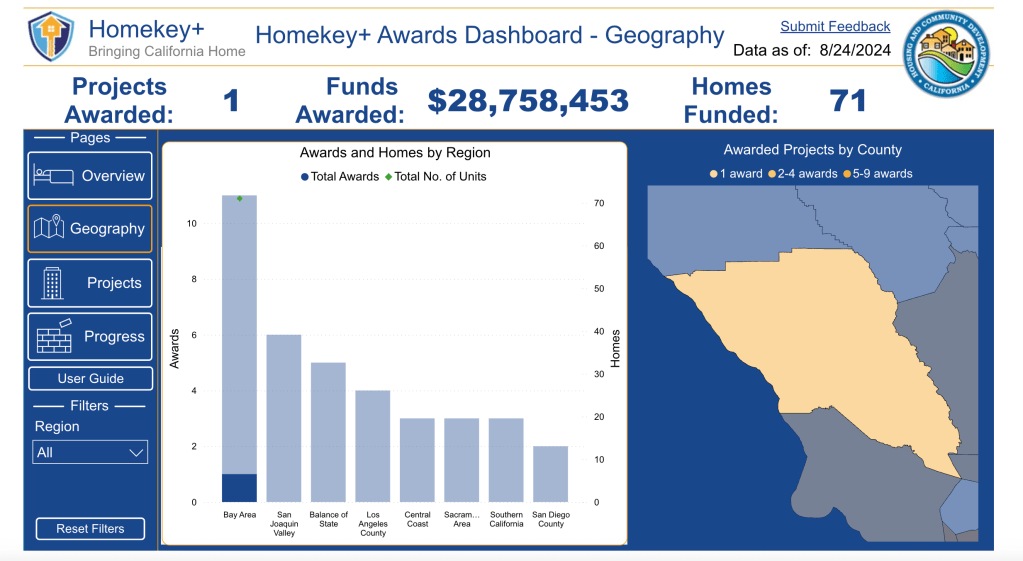
Just last week, HCD announced another five awards through Proposition 1-funded Homekey+ to create permanent supportive housing for veterans and other Californians with behavioral health challenges. So far in 2025, Homekey+ has awarded $636.1 million to create 37 affordable housing communities with wrap-around services. These communities will add 1,817 new homes, with 454 reserved for veterans. The acquisition and rehabilitation of 6500 Redwood Drive in Rohnert Park was awarded $28,758,453 to Burbank Housing Development Corporation.
“From funding the creation of ADUs and permanent supportive housing to preserving affordable homes for future generations, today’s awards highlight the Newsom Administration’s innovative approach to addressing homelessness and tackling California’s affordable housing crisis,” said HCD Director Gustavo Velasquez. “As we approach the New Year, we reaffirm our commitment to working with our partners to support our communities and build more housing for all.”
Earlier this year, Governor Newsom announced multiple awards to support communities, address homelessness and provide much-needed housing:
Earlier this year, Governor Newsom announced multiple awards to support communities, address homelessness and provide much-needed housing:
- $118.9 million from the HOME Investments Partnerships American Rescue Plan and the Emergency Solutions Grants programs to fund the development of 487 homes, support emergency shelters and homeless outreach, and provide rapid rehousing and supportive services.
- $144.5 million from the HOME Investment Partnerships Program to build multi-family and single-family homes and support local housing assistance programs.
- Nearly $52.6 million from the Disaster Recovery Housing Accelerator Program to help jumpstart construction in two counties severely impacted by winter storms. The Saggio Hills Phase II Development for 41 units in Healdsburg was awarded $11,598,206 and 9% in tax credits to Freebird Development Company. The Dry Creek Commons Project in Healdsburg for 36 units was awarded $8,708,426 and 4% in tax credits to Burbank aHousing Development Corporation. The Redwood Glen Apartments in Windsor for 20 units was awarded $2,266,296 and 9% in tax credits to JCL Development.
- $56 million in Transitional Age Youth Program grants to 54 counties to help provide services and housing for foster youth and young adults at risk of homelessness.
- $181.1 million from the Homeownership Super NOFA program to help thousands of low-income Californians attain or maintain the dream of homeownership.
- $835.3 million from the Affordable Housing and Sustainable Communities program to fund infrastructure and 2,393 new affordable rental homes.
$52.6 million from the Community Development Block Grants and Emergency Solutions Grant programs to build housing, address homelessness and revitalize communities.
In September, Governor Newsom announced $414 million in awards from the Multifamily Finance Super NOFA (MFSN) program to help create 2,099 new homes, with 2,068 reserved for low to extremely low-income Californians. HCD also announced a special MFSN NOFA (MFSN-LA Disaster) to provide an additional $101 million to support recovery and rebuilding efforts from 2025 wildfires within Los Angeles County. Those awards will be announced in early January 2026.
 Homeless Emergency Assistance Program Association